
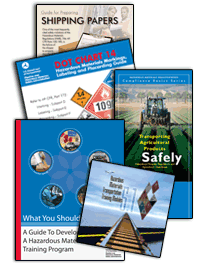
 Yesterday I shared the link to the Department of Transportation’s (DOT) Pipeline and Hazardous Material Safety Association’s (PHMSA) free training modules on my Facebook page and Twitter account. I wanted to use this post to discuss the training requirements for the Department of Transportation Hazardous Materials. In Are you Shipping Batteries? I mentioned that for many companies, hazardous material (hazmat) transportation is one of the greatest areas of non-compliance. Over the past ten years I have worked with a number of manufacturing companies and, for some reason, hazmat transportation is typically an area of deficiency and it begins with training. Let’s begin the discussion with which employees are required to take the Department of Transportation’s Hazardous Material Training (HMR)? The DOT requires training for “any employee whose work directly affects hazardous materials transportation safety.” Training is required within 90 days of an employee’s start date or transition into a position that includes hazmat transportation responsibilities—during this 90 day period, the untrained employee must be under the direct supervision of a trained hazmat employee.
The HMR includes both raw materials and hazardous waste (see What is Hazardous Waste?). If an employee affects the transportation of either of these HMR training is required. Employees who load and unload packages, prepare shipping documentation, package the materials, ship and/or receive all “affect transportation.” Often employers or employees do not realize they are shipping hazardous materials. Generally, if a the material requires a Material Safety Data Sheet (MSDS) also known as a Safety Data Sheet (SDS) or if the material(s) meet the definition of a hazardous waste the HMR most likely apply. Click here to see a list of hazardous materials that are typically shipped undeclared (or shipped illegally). The DOT requires training to include this following topics:
- general awareness/familiarization;
- function-specific;
- safety;
- security awareness;
- In-depth security training, if a security plan is required; and
- driver training (for each hazmat employee who will operate a motor vehicle).
In addition to the initial training, refresher training must be given every three (3) years. As with all compliance training, documentation is extremely important. Training records must include: hazmat employee’s name; completion date of most recent training; training materials (copy, description, or location); name and address of hazmat trainer; and certification that the hazmat employee has been trained and tested. What You Should Know: A Guide to Developing a Hazardous Materials Training Program, is a great FREE resource for development of a hazmat training program.
Do you have additional questions about hazardous materials training requirements? If so leave a comment below or contact me for a free hazmat consultation.
2 thoughts on “Hazmat Transportation Training, Do You Need it?”
Comments are closed.