
Most organizations have a safety committee. Meetings are scheduled, agendas are reviewed, and minutes are recorded. Yet simply having a committee does not necessarily mean it is contributing meaningfully to safety performance.
We’ve explored why many safety committees underperform and what high-performing committees tend to do differently. In a follow-up article, we also outlined eight elements that high-impact safety committees often have in common, including leadership support, structured processes, balanced participation, and meaningful measurement.
These discussions raise an important question: Is your safety committee truly effective?
For many organizations, answering that question requires looking beyond whether meetings occur regularly and instead evaluating whether the committee actually influences how safety information flows through the organization.
Signs Your Safety Committee May Be Ineffective
Safety committees rarely become ineffective because people lack commitment. More often, the issue is structural. When committees are not intentionally designed to support engagement, accountability, and problem-solving, their impact can gradually diminish.
Organizations may notice signals such as:
- Meetings focused primarily on reviewing past incidents rather than identifying emerging risks
- Limited participation and engagement among committee members
- Action items that remain unresolved across multiple meetings
- Unclear ownership of decisions or follow-through
- Limited connection between committee discussions and broader organizational goals
When these patterns appear, the committee may begin to function more as an administrative exercise than a meaningful forum for improving safety performance.
Recognizing these signals is an important first step toward strengthening committee effectiveness.
Checking the Box vs. Driving Effectiveness
In many organizations, the difference between an unsuccessful committees and an effective ones comes down to how the committee is structured and how it operates.
The comparison below illustrates some of the patterns that commonly emerge.
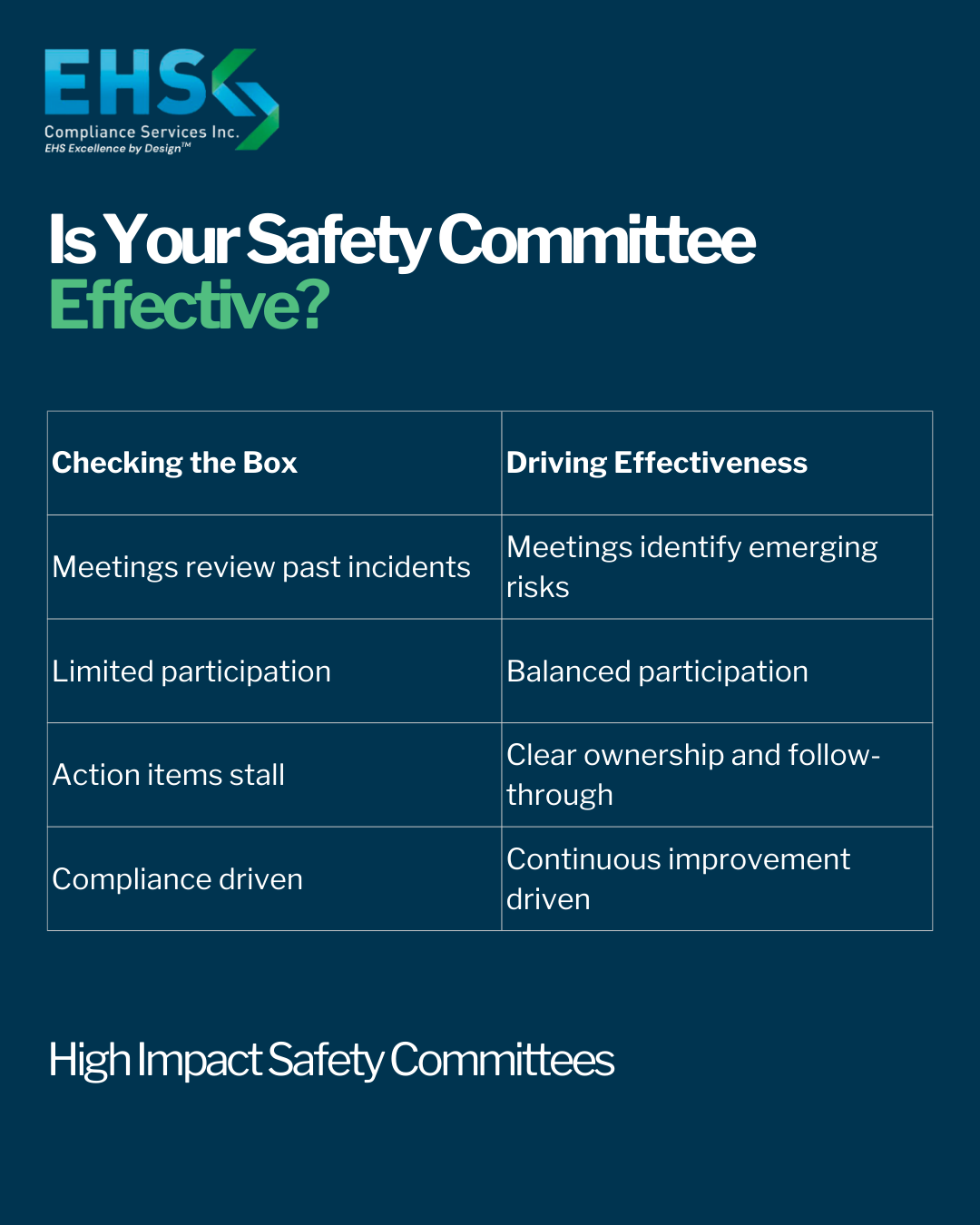
Committees that primarily review past incidents, struggle with limited participation, and allow action items to stall often become compliance-focused. Their work may be well intentioned, but the structure does not consistently translate discussion into action.
Effective committees operate differently. They create a forum where emerging risks can be identified early, participation is balanced across the organization, and responsibility for follow-through is clearly defined.
Over time, this shift changes the committee’s role from simply reviewing what has already happened to helping the organization anticipate and manage EHS risks more proactively.
Why Effectiveness Matters
Safety committees exist in many organizations because they are recommended as a best practice for engaging employees and strengthening communication around workplace safety. However, the real value of a committee lies not in the fact that it exists, but in how effectively it functions.
When safety committees operate effectively, they create a structured forum where frontline experience, operational insight, and leadership priorities come together. This allows organizations to identify risks earlier, address concerns more collaboratively, and strengthen the flow of safety information throughout the organization.
Effective committees also help clarify accountability. When issues are discussed openly and ownership is clearly assigned, organizations are better positioned to follow through on improvements and sustain progress over time.
Without that structure, committees may meet regularly but struggle to influence operational decisions or organizational priorities.
Ultimately, safety committee effectiveness is less about the frequency of meetings and more about whether the committee helps the organization identify, communicate, and address risks more effectively.
A Question Worth Asking
For leaders evaluating their current approach, one question can be helpful:
Is our safety committee influencing EHS performance or just meeting arbitrary requirements?
Answering that question often reveals opportunities to strengthen both the committee itself and the broader safety management system that supports it.
Continuing the Conversation
For organizations interested in strengthening the impact of their safety committees, we will be exploring these ideas in more detail during an upcoming session:
Safety Committees That Work: 8 Keys for Real Results
This session will focus on practical ways organizations can improve committee design, strengthen participation, and translate discussions into measurable results. If your organization is currently evaluating the effectiveness of its safety committee, this conversation may provide useful perspective.
Frequently Asked Questions
How can you tell if a safety committee is effective?
An effective safety committee does more than meet regularly. It helps identify emerging risks, encourages balanced participation across roles, and ensures that discussions lead to clear actions and follow-through that improve safety performance.
Why do safety committees often lose effectiveness over time?
Many committees become administrative when their purpose is unclear, participation declines, or action items are not consistently tracked to completion. Without structure and leadership support, meetings can become routine rather than impactful.
How can organizations improve safety committee effectiveness?
Organizations can strengthen committees by clarifying their mandate, encouraging balanced participation, establishing structured processes for problem-solving, and ensuring that recommendations connect to operational decisions and organizational goals.