
In many organizations, EHS programs are designed with the right intent.
They’re structured.
They’re documented.
They check the right boxes.
But they don’t always work the way they’re expected to. The issue isn’t effort. It’s how those systems are designed.
Too often, EHS is developed for the organization and the workers, not with them.
- Procedures are written without input from the people doing the work.
- Programs are rolled out without fully understanding operational realities.
- Expectations are set without shared ownership.
And over time, that creates a disconnect. Between what’s written and what actually happens in the field or work as imagined and work as done.
That’s where collaboration becomes more than a value. It becomes a requirement to create effective EHS systems.
What Collaboration Actually Means
Collaboration isn’t just involving people in conversations. It’s about co-designing how work gets done safely and effectively.
That means:
- Engaging the people closest to the work
- Understanding how tasks actually happen—not how they’re assumed to happen
- Building systems that reflect real conditions, not ideal ones
When that happens, something shifts. EHS stops feeling like an external requirement. And starts becoming part of how the business operates – it becomes embedded in how the business operates each day.
What It Looks Like in Practice
In organizations where collaboration is embedded:
- EHS is including in business strategy and operational plans
- Business performance metrics include the identification and consistent monitoring of EHS Key Performance Indicators (KPIs)
- Near misses are treated as learning opportunities where information sharing is valued
- Procedures reflect real workflows and or not simply written expectations
- Hazards and risks are identified as a part of ongoing assessment
- Improvements are continuous—not reactive
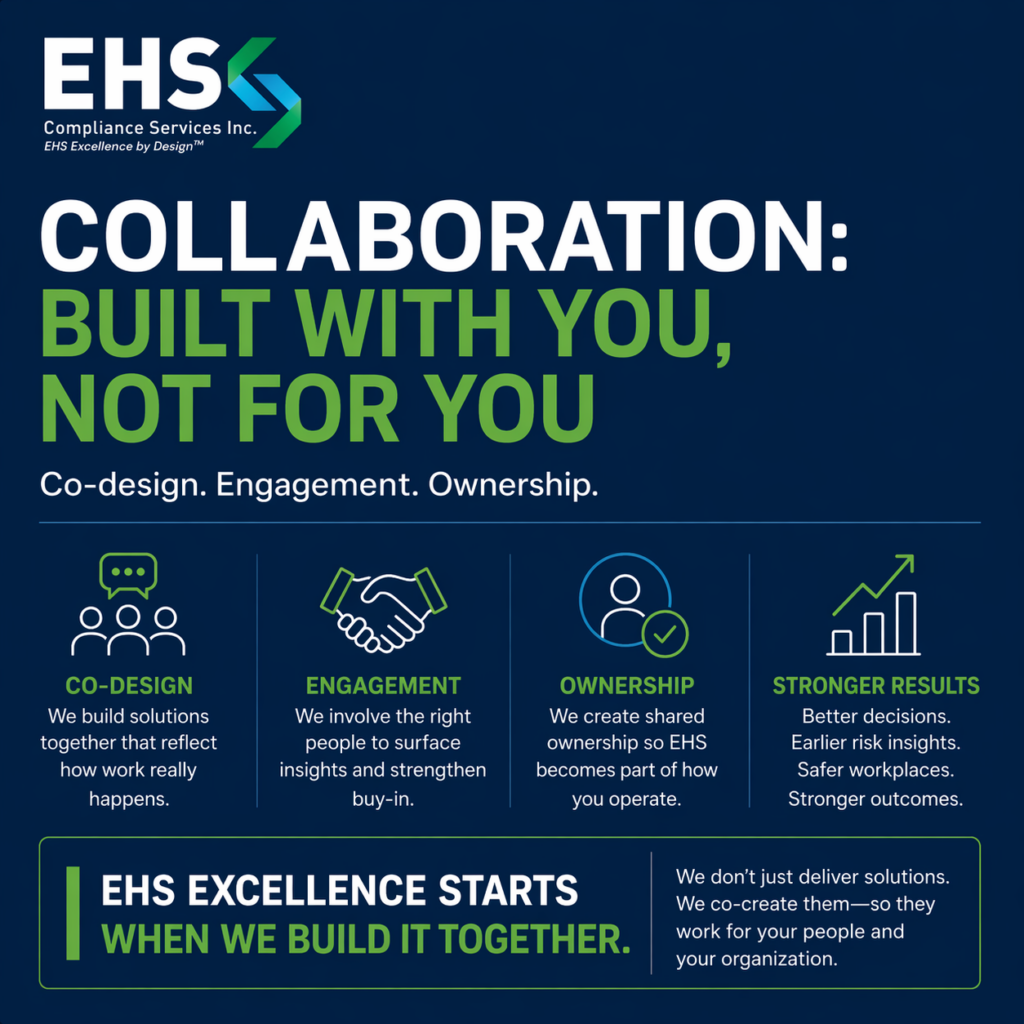
This is where organizational alignment begins. Not through enforcement but through worker engagement and involvement.
Why It Matters
When EHS is built in isolation, even well-designed programs fall short, often because they don’t fully account for how work actually happens.
But when EHS is designed built with the organization, the workers performing the tasks, safety work procedures are more easily adopted, compliance gaps are identified earlier, there is a forum for hazards and risks to surface, and corrective and preventive actions are implemented more consistently:
Collaboration doesn’t slow things down. It strengthens how decisions are made.
The Shift
This leads to a change in perspective, where leaders ask “Was our EHS system built with the people who have to make it work?” not simply “Did we design an EHS system?”
If your EHS programs are well-designed, but not consistently adopted, it may be time to look at how they were built.
Collaboration is one of our core values. Because EHS systems are only effective when they’re built with the people who rely on them every day.
Our team of EHS experts, help organizations strengthen how EHS systems are developed,
so they reflect real work, real risks, and real ownership.