
Most workplace safety conversations focus on visible risks: falls, machinery, chemicals, or electrical exposure.
These are real, regulated, and actively managed.
But there is another category of risk causing far more deaths each year — and it’s often not managed systematically: psychosocial risk.
Over the past 15 years of working with organizations across industries, we’ve seen a consistent pattern: when serious incidents occur, the root causes are rarely just physical hazards. They are tied to how work is structured, how decisions are made under pressure, and the conditions people are operating within every day.
If we’re serious about preventing fatalities, we have to look beyond hazards—and examine the conditions that influence how people interact with them.
The Numbers Behind the Issue
On April 22, 2026, the International Labour Organization (ILO) released The Psychosocial Working Environment, a comprehensive global report that puts hard data behind what our team and many other EHS professionals have observed for years.
The findings are significant:
- Over 840,000 deaths per year are linked to psychosocial risks at work, primarily through cardiovascular disease, mental health disorders, and suicide
- 45 million disability-adjusted life years (DALYs) are lost annually as a result
- The economic cost is estimated at 1.37% of global GDP each year
- Depression and anxiety alone account for 12 billion lost workdays per year, according to the World Health Organization
To put that in perspective, the number of deaths attributed to psychosocial risks exceeds many of the most well-known occupational hazards combined.
These aren’t statistics from a distant sector. They reflect what is happening inside organizations across every industry, including manufacturing, logistics, energy, construction, and industrial operations.
Why This Matters for Serious Injuries and Fatalities
Psychosocial risks are often treated as separate from traditional safety risks.
But in practice, they are deeply connected.
These factors influence:
- Attention and situational awareness
- Decision-making under pressure
- Fatigue and cognitive performance
- Risk tolerance and shortcut-taking behavior
In many serious incidents, the physical hazard is only one part of the story.
The conditions surrounding the work—tight timelines, competing priorities, unclear expectations, or chronic workload pressure—shape how people interact with those hazards.
And in some cases, they increase the likelihood that a routine task becomes a serious event.
What Are Psychosocial Risks — And Why Are They Growing?
Psychosocial hazards are aspects of how work is organized, managed, and experienced that have the potential to cause psychological or physical harm. Psychosocial risks arise from exposure to these hazards—specifically the frequency, duration, and intensity with which workers experience them within the work environment.
Psychosocial hazards include work-related conditions such as long working hours, job insecurity, excessive workload, workplace conflict, imbalances between effort and reward, and low levels of control or autonomy—conditions that, when experienced repeatedly or intensely, contribute to increased psychosocial risk.
These are not individual issues. They are organizational conditions—which means they can be measured and improved.
At the same time, the problem is accelerating.
Work is evolving faster than EHS systems can adapt.
Digitalization and AI are reshaping job content, increasing monitoring pressure, and introducing new forms of cognitive demand that existing risk frameworks were not designed to capture.
Remote and hybrid work has blurred the boundaries between professional and personal life. Without deliberate organizational design, this boundary erosion becomes a persistent stressor.
New employment models—including gig work, platform labor, and short-term contracting—are expanding the workforce while simultaneously reducing the protections and stability that help buffer psychosocial risk.
The ILO’s message is direct: these changes are not going to slow down.
But the harm they create is preventable—if organizations choose to act.
What Effective Action Looks Like
Most organizations have strong frameworks for managing physical risks.
Standards, controls, and inspections are well established.
Psychosocial risks are different. They are less visible, require employee trust and input, and must be integrated into operations, not isolated within Human Resources.
As a result, many organizations have not yet built this capability.
But unmeasured risk is still risk—just unmanaged.
A More Structured Way to Understand Psychosocial Risk
To move beyond awareness, organizations need a structured way to understand how psychosocial conditions show up in the workplace—and how they influence safety outcomes.
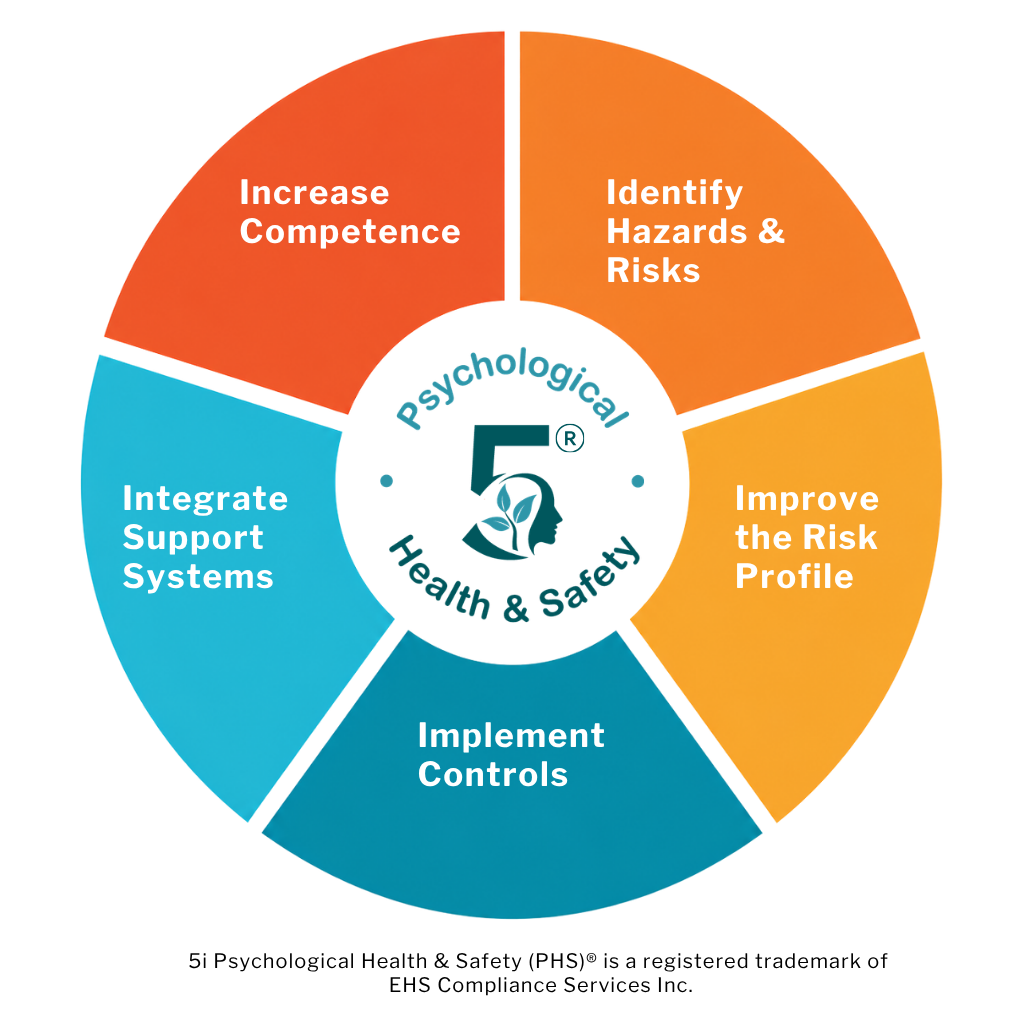
Our 5i Psychological Health and Safety® (5i PHSTM) methodology provides that structure:
Increase Competence
Build shared understanding across the organization by developing awareness of psychosocial hazards, their impact on human performance, and their role in health and safety outcomes.
Identify Hazards and Risks
Surface psychosocial hazards and assess exposure by examining how work is designed, organized, and managed, including social, environmental, and task-related conditions.
Improve the Risk Profile
Analyze and prioritize psychosocial risk drivers based on their impact on human functioning and overall risk, enabling targeted and informed decision-making.
Implement Controls
Design and apply interventions that address root causes—modifying work design, leadership practices, and system conditions to reduce exposure to risk.
Integrate Support Systems
Establish and strengthen support structures that help workers respond to and recover from psychosocial risks, complementing upstream prevention efforts.
Why This Matters
Without a structured approach, psychosocial risks remain:
- Difficult to measure
- Disconnected from safety outcomes
- Treated as a “culture issue” rather than an operational risk
The 5i PHSTM methodology bridges that gap by linking organizational conditions directly to system performance and risk exposure.
For organizations already working within frameworks such as ISO 45001, this creates a practical path for integrating psychosocial risk into existing EHS systems with the same rigor applied to physical hazards.
What Comes Next
Understanding the connection between psychosocial risks and serious outcomes is only the first step. The bigger challenge is this:
- How do you measure it in a way that informs real decisions?
- How do you identify where risk is building before it results in an incident?
- And how do you integrate those insights into existing systems—not as a separate initiative, but as part of how work gets done?
To address these gaps, we’re currently developing a new assessment approach grounded in our 5i PHSTM methodology .
Later this year, we’ll be working with a small group of organizations to pilot and refine it. The question isn’t whether your organization has psychosocial risks.
Every workplace does.
The real question is whether those risks are being systematically identified, measured, and managed before they contribute to harm.
Organizations that act now will be better positioned to strengthen resilience, improve decision-making, and prevent the kinds of failures that traditional hazard-based systems alone cannot fully address.
Learn more about 5i Psychological Health and Safety® Methodology
What is 5i PHSTM methodology ? https://www.ehscsi.com/blog/2025/06/12/what-is-the-5i-methodology/
Who Benefits from 5i PHSTM ? https://www.ehscsi.com/blog/2025/07/14/who-benefits-most-from-the-5i-psychological-health-and-safety-methodology/