
The world’s most adopted environmental management standard just got a major upgrade, and the clock is ticking.
If that question gave you pause, you’re not alone; many organizations are in the same position as they start to understand what this update means in practice.
In April 2026, ISO officially published the updated ISO 14001:2026, the most significant revision to the world’s leading environmental management standard in over a decade. Organizations that act early can gain a real competitive edge. Those who wait may scramble to catch up before the 2029 transition deadline.
Let’s break it all down — what the standard is, why it matters, and what’s new in the 2026 edition.
ISO 14001: The Standard That Keeps Businesses Accountable
This internationally recognized framework helps organizations build and maintain an Environmental Management System (EMS)—a structured approach to identifying, controlling, and continually improving environmental impact.
Think of it as the operating system for your environmental performance. It doesn’t dictate specific targets, but it ensures you have a credible, auditable process to set goals, track progress, and demonstrate accountability to your stakeholders including regulators, clients, and shareholders.
At its core, it is built on the Plan-Do-Check-Act (PDCA) cycle, the same continuous improvement logic behind ISO 9001 (quality) and ISO 45001 (occupational health & safety), making integration with other management systems seamless.
Why Should Your Organization Care?
Implementing ISO 14001 is no longer just a “nice to have”; it has become a business imperative. Here’s why forward-thinking organizations are prioritizing it:
- Regulatory Confidence: A structured EMS helps you stay ahead of environmental regulations, reducing the risk of fines, penalties, and shutdowns.
- Investor & stakeholder trust: ESG and sustainability expectations are rising. This certification sends a credible signal to investors, boards, and partners.
- Cost efficiency: Systematic tracking of energy, water, raw materials, waste, and emissions consistently reveal opportunities to cut costs and reduce waste.
- Client requirements: Large corporations and governmental bodies increasingly require this certification in the supplier qualification processes.
- Brand & reputation: Consumers and communities reward transparency. Certification shows your environmental claims are backed by a verifiable system.
- Operational resilience: Organizations with mature EMSs better adapt to climate-related disruptions and evolving sustainability expectations.
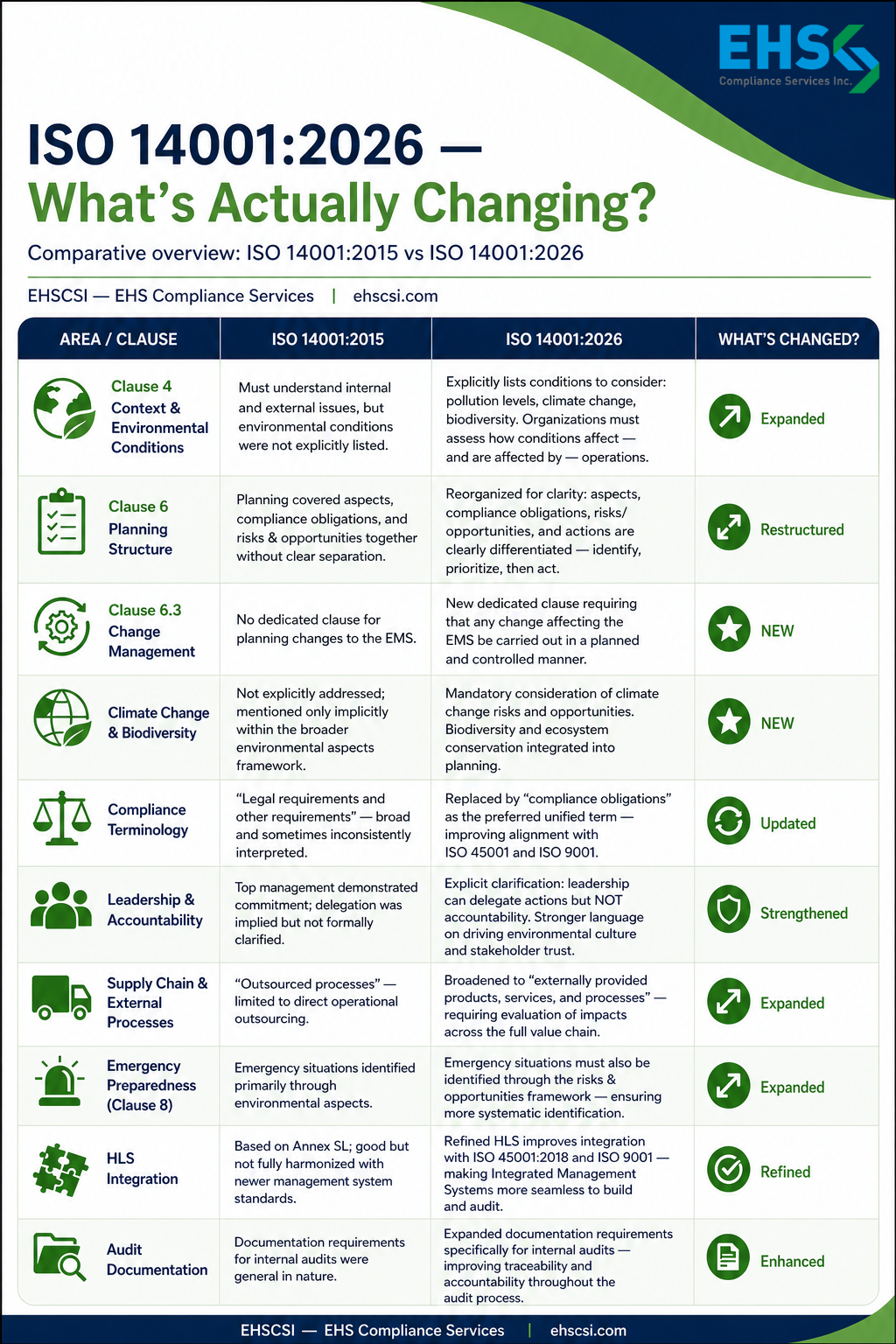
ISO 14001:2026 — What’s Actually Changing?
The good news is that the 2026 revision builds on what already works; it’s an evolution, not a complete overhaul. The core structure and PDCA approach remain unchanged. What’s new are focused, high-impact updates that reflect today’s realities: increasing climate urgency, rising biodiversity concerns, and stronger expectations for accountability.
Ready to take the next step? Don’t Navigate ISO 14001:2026 Alone
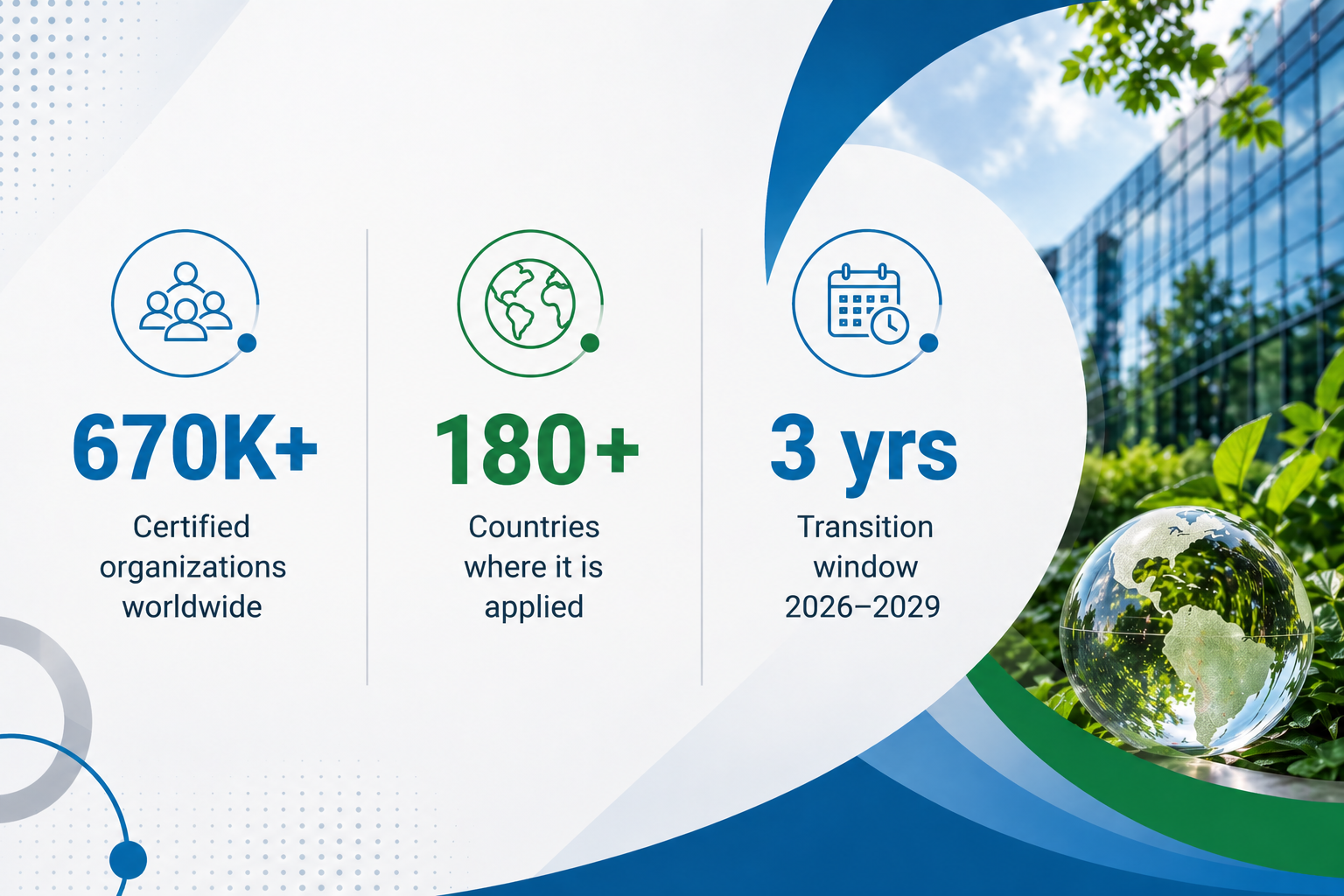
Organizations already certified under ISO 14001:2015 have a three-year window (2026–2029) to complete their transition. And those who start now will adapt more strategically, with less disruption and at a lower cost.
Your Transition Roadmap
- Conduct a gap analysis
- Update context & risk assessments
- Align leadership and documentation
- Train your team
- Engage your certification body
Our Management System Implementation team, including certified lead auditors, has deep expertise in ISO 14001 and ISO 45001, from gap analysis and system design to full certification support. We don’t just help you conform; we help you build a system that drives real environmental performance and long-term business value.
What This Looks Like in Practice
In our work with large, highly regulated organizations, we often see a common misconception: that the value of ISO comes only from pursuing certification.
In reality, many organizations use ISO as a framework, not a certificate—and still achieve a high level of credibility and discipline.
We supported a global life sciences organization that chose not to pursue ISO certification. Instead, the organization used ISO 14001 and ISO 45001 as frameworks to design and strengthen its enterprise EHS Management System.
After completing a structured gap assessment and closing identified system gaps, the organization engaged EHS Compliance Services as an independent third party to validate its self‑declaration of conformance. The outcome wasn’t a certificate; it was confidence: confidence in leadership accountability, risk management, system integration, and continuous improvement.
This level of maturity is exactly what the 2026 update is reinforcing. Organizations that have built strong systems—not just documents—are far better positioned to absorb standard updates without disruption.
Read the case study:
Using ISO as a Framework to Strengthen a Global EHS Management System
Save it, Share it with your team, or pass it along to someone who’s asking the same questions about ISO.
Every strong system starts with an honest conversation. If you’re ready to have that conversation, we are too! 👉 Schedule a call with us here.