
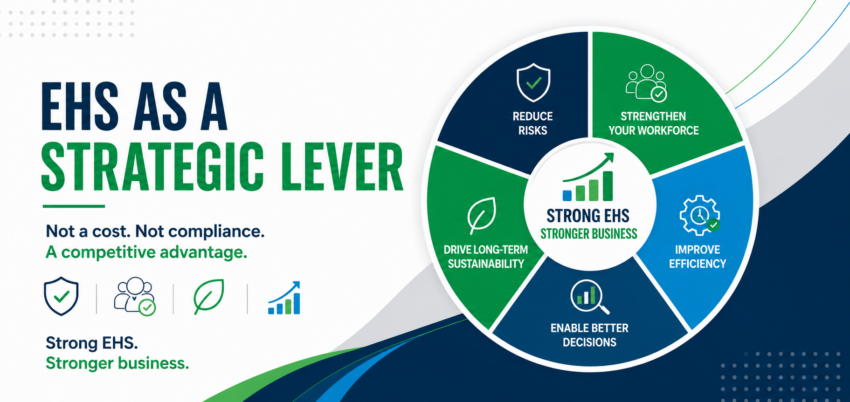
Most organizations treat EHS as a cost of doing business or overhead. The best ones treat it as a competitive advantage.
There’s a conversation happening in boardrooms and leadership meetings across every industry — and EHS rarely gets a seat at the table. Budget discussions, operational priorities, workforce strategy, long-term sustainability— these are treated as business conversations. EHS is typically treated as a compliance conversation.
That separation is costing organizations more than they realize.
The “cost center” myth
When EHS lives in the compliance column, it gets managed accordingly. Minimum requirements, reactive responses, budget pressure every cycle. The goal becomes “don’t have incidents” and that’s not a strategy. It’s a hope.
The problem isn’t that organizations don’t care about safety or environmental responsibility. Most do. The problem is that they haven’t connected EHS performance to the metrics leadership actually manages — operational efficiency, workforce retention, risk exposure, reputation, and long-term profitability.
When that connection gets made, everything changes.
Risk reduction is a business outcome
Every uncontrolled hazard in an operation is a liability that hasn’t materialized yet. Every near miss that doesn’t get reported is a pattern that doesn’t get addressed. Every regulatory gap is a fine, a shutdown, or a headline waiting to happen.
Strong EHS systems don’t just reduce injuries, they also reduce uncertainty. And in business, uncertainty is expensive. When leadership has clear visibility into risks across their operations, they make better decisions. They allocate resources more accurately. They catch problems before they become crises.
That’s not a EHS metric. That’s operational and decision intelligence.
Another common misconception is that efficiency and EHS are in opposition to each other— that time spent assessing risk or fixing processes comes at the expense of productivity. The data tells a different story. Organizations with mature EHS systems consistently outperform on operational efficiency because the discipline required to manage EHS well — standardized processes, clear accountability, real-time monitoring, and continuous improvement, is the same discipline that drives operational excellence. You can’t have one without building the foundation for the other. When EHS is integrated into operations rather than siloed outside of daily operations, it becomes a lever for efficiency.
Your workforce is watching
Your workforce can tell the difference between an organization that treats EHS as a core value and one that treats it as paperwork. They see it in the day-to-day — in the culture, in how leadership responds to concerns, and in whether systems are built to protect them or simply to prove that protection was attempted.
This matters more than most executive teams acknowledge. Workforce engagement, retention, and performance are directly tied to whether people feel safe — physically and psychologically — at work. Organizations that invest meaningfully in EHS don’t just reduce turnover costs. They build the kind of workplace culture that attracts people who take their work seriously.
In a tight labor market, that’s a strategic advantage.
What Leaders Can’t See Will Cost Them
The real value of a strong EHS system isn’t the paperwork; it’s the clarity it creates. What separates organizations with mature EHS programs from those without, is information quality.
A mature EHS management system gives leadership something most organizations lack — reliable, real-time visibility into what’s happening across their operations. Where the risks are. Where performance is decreasing. Where controls something aren’t being utilized or failing to operate correctly. Where efficiency gains are possible.
Most executive decisions are made with incomplete information. EHS systems, when designed well, close that gap. They surface the information leadership needs to make faster, more informed decisions — not just about EHS, but about the organization as a whole.
That’s the kind of value that shows up in the P&L.
And that visibility matters even more in the long game.
Investors, customers, regulators, and employees are all asking harder questions about organizational sustainability than they were five years ago. Environmental performance. Worker well-being. Governance and accountability. These are no longer peripheral concerns; they are criteria for partnership, investment, and talent.
Organizations that have built strong EHS systems are better positioned for what’s coming. Not because they checked the right boxes, but because they built the organizational muscle to manage complexity, absorb change, and perform consistently under pressure.
That muscle takes time to build. The organizations starting now will have it when it matters most.
What We Really Need to Ask
If the answer centers on incidents avoided and audits passed, there’s an opportunity. A real one.
EHS done well doesn’t just protect people and the environment — it improves operations, strengthens culture, reduces risk exposure, and informs better decisions at every level of the organization. That’s not a compliance function. That’s a strategic lever.
If you’re ready to evaluate whether your EHS efforts are creating a measurable impact — and what it would take to get there — we’d love to have that conversation.