
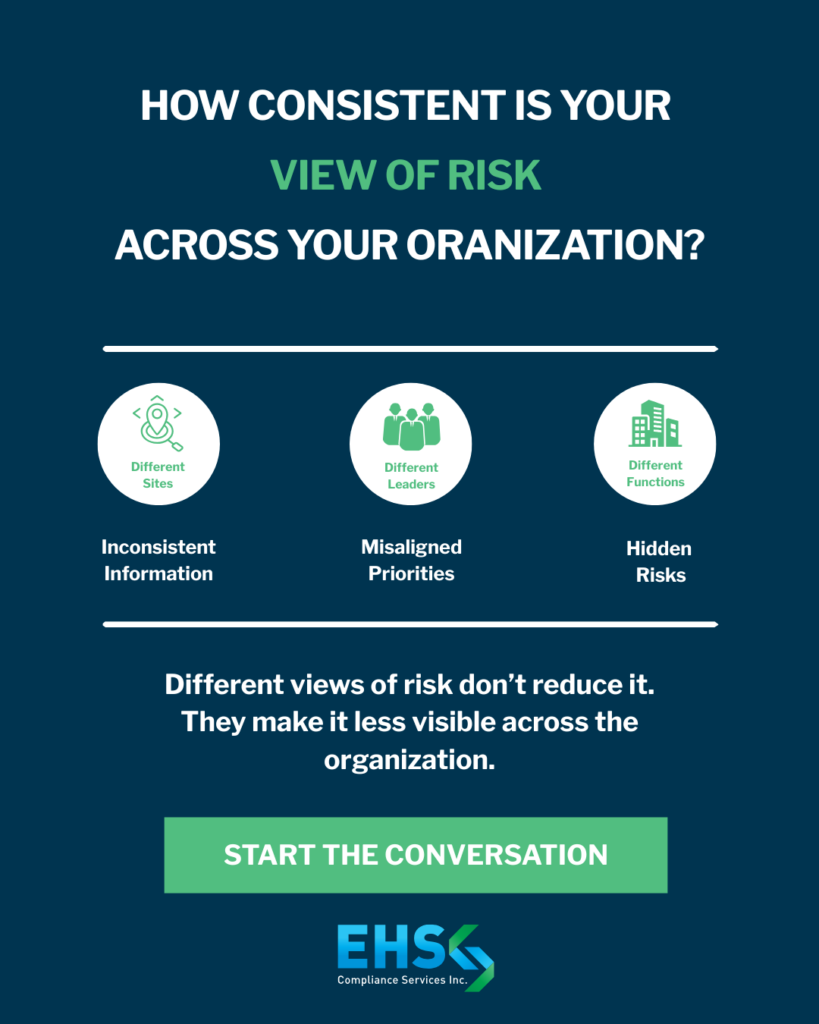
EHS risk management often breaks down in organizations where responsibility is distributed—but visibility is not.
Most organizations understand that EHS is important.
At the leadership level, accountability is clear—even if execution is delegated across operations, EHS teams, and site leadership. And that’s how it should be.
Strong organizations rely on strong leadership teams. However, in many cases, that delegation unintentionally creates separation. And when EHS operates in silos, hazards and risks do not disappear, they simply become fragmented.
The Challenge: Fragmented Visibility of Risk
In many organizations, the effort is there. Incidents are investigated. Audits are completed and corrective actions are implemented.
But these activities typically happen within functions or locations and often not across the enterprise. In multi-site organizations or those with complex operations, this challenge becomes even more pronounced.
From what we’ve seen, each site may manage hazards and risks slightly differently. Metrics may not align, and insights gained in one location don’t always carry over to another.
The result is that similar issues can occur across the organization—sometimes repeatedly—because the root causes were never addressed at a system level.
Hazards and risks do not just exist in silos. In many cases, they repeats across them.
When EHS Becomes Reactive
In many organizations, EHS gains visibility when something triggers it.
An agency visit.
An corporate or third party audit.
A serious injury.
An environmental incident.
A significant operational disruption.
These moments often drive action and attention. However, they also highlight a deeper issue—EHS is engaged only after an event has materialized.
At that point, the organization is no longer managing risk. It is managing consequences.
The Limitation of Compliance Alone
Many organizations take confidence in being compliant—and that’s important.
But compliance alone does not provide a complete picture of risk.
It does not always reveal how risks connect across the organization, nor does it ensure those risks are consistently identified, managed, or controlled.
An organization can meet regulatory requirements and still have gaps in how risk is identified, communicated, and managed at the enterprise level.
The goal is not just compliance. The goal is risk identification, management and control.
What It Means to Embed EHS
Embedding EHS means integrating it into how the business operates, not treating it as a separate function.
It becomes part of:
- Decision-making
- Performance management
- Operational planning
- Strategic discussions
- Budget allocations
- Overall enterprise risk management
EHS is considered alongside revenue, costs, quality, production, research and development.
Not only when required, but as a driver of overall business performance.
From Functional Responsibility to Enterprise Strategy
When EHS is embedded effectively, the shift is noticeable.
Risk is understood across the organization, not in isolated pockets.
Root causes are addressed systemically, not just locally.
Leaders operate with more consistent, reliable information.
This creates a more complete and accurate view of enterprise risk. And it positions the organization to act proactively rather than reactively.
Why This Matters for Leadership
For leadership teams, this isn’t just an EHS issue—it’s a enterprise risk management issue. Without a consistent view of risk, decisions are made with incomplete information. And over time, that impacts performance, reliability, and trust across the organization.
A Practical Starting Point
For organizations looking to move in this direction, a simple starting point is this:
Identify where EHS is still operating in isolation.
In multi-site and complex environments, those gaps often indicate where risk management may be fragmented. Addressing those gaps is the first step toward embedding EHS as a true enterprise capability.
Start with one question: How consistent is your view of risk across your organization?
If that answer varies by site, function, or leader, there may be gaps in risk management across the organization.
We’re always open to a conversation about what this could look like in your organization.